You might remember that I used some pictures from Alice in Wonderland and 1984 to illustrate some of the fundamental problems with the Treaty Principles Bill, in part to demonstrate that David Seymour’s carefully-curated goofy everyman image obscures a strongly authoritarian streak – when he says libertarian, he doesn’t mean liberty for YOU.
I have tried to find some suitable similar images to help illustrate the evil that sits behind the Regulatory Standards Bill. The obvious allusion is to the Trojan Horse – hidden inside something that looks like it should be welcomed are enemy soldiers (or malware to refer to the more modern version). But the Trojan Horse metaphor isn’t quite right. For one thing, there aren’t throngs of people welcoming the Bill. You will have heard that almost all of the submissions made on the discussion document opposed the advancement of this Bill (just 0.33% of submissions – 76 in number, no doubt from ACT Party members, astroturf organisations and the Business Roundtable – supported it).
The other problem with the metaphor is that in the case of the RSB the enemy soldiers aren’t actually hidden, they’re in plain sight. There’s a trope in science fiction and in some children’s literature of a person who is so boring and dull that they are invisible to others, and able to get away with anything. This is obviously something that’s more difficult to illustrate (!) but is probably a better metaphor.
Part of the problem in addressing the Bill is that it sounds dull but inherently a good thing – ensuring that regulation meets certain quality requirements. Actually, though, it is one of the three legs of the ACT Party’s agenda to fundamentally change the society in which we live. The ACT Party is pursuing the privatisation of public assets, they are pursuing the privatisation of what are currently public services (like health and education), and the point of this Bill is deregulation – to elevate private property rights, including those of companies, into a quasi-constitutional status, over and above considerations such as public good, community welfare, environmental protection, health and safety and the Te Tiriti o Waitangi. Regulation (both statute and regulations issued pursuant to a statute) is too often dismissed as unhelpful or obstructive red tape. In reality regulation is the usual way that society restricts and directs behaviour to protect the vulnerable and advance the common good.
If the Bill were to be passed in its current form these regulations would fail the standard set unless we could show that they were necessary to protect the liberty, freedom or rights of another person. “Necessary” is a very high standard in law: it requires that the objective could not be met without the measure. Be aware too that ACT has a very different idea of what “rights” are.
There are some things in the Bill that are laudable. For example, it’s a good idea to clearly state what problem regulation is attempting to solve, and to properly explore all the alternative ways of addressing it. It’s a good idea to have regulation worded clearly and unambiguously. It’s a good idea to properly seek the views of those who will be affected by a proposed regulation. There should be an avenue for reconsideration of regulation that is claimed to be unfair. But the problem is that all this already exists (Regulatory Impact Statements, the Legislative Design Advisory Committee, the Regulations Review Committee, Judicial Review, Cabinet Manual and so on). While it’s always possible to make further quality improvements, the good parts of the Bill are essentially unnecessary duplication
But, of course, the Bill isn’t really aimed at achieving better regulation; it’s about having less regulation, and having what regulation remains consistent with the political values of libertarianism and the ACT Party.
The importance of the Bill to ACT’s privatisation and deregulation agenda is shown by the doggedness with which they have pursued it. The idea for a Bill like this originated with the Business Roundtable (now the NZ Initiative) and ACT has tried, and failed, three times already since 2001 to advance essentially the same Bill. Once it failed its First Reading and twice it went to Select Committee, where it was rejected unanimously. The expert advice, including from officials, and submissions on those previous attempts give us some useful analysis of the Bill. They agree that it represents unnecessary duplication, adding little if any value (“ineffective and unnecessary” according to Treasury), they say the cost of implementing may outweigh any benefit, and that the risk of unintended consequences is high. Professor Richard Ekins at the University of Auckland, called it “hostile to our democratic constitutional order”. While of course we haven’t yet seen the submissions made on the Bill, experts are once again sounding the alarm about this latest attempt. The Ministry for Regulation has been responsible for developing the Bill, under the direction of its Minister, Hon. David Seymour, and – extraordinarily – even they have recommended against the Bill, noting that it’s unclear what problem the Bill is intended to solve, and that to the extent that a problem exists, the Bill is not the best way of addressing it.
I know the so-called Treaty Principles Bill (sorry, “The Principles of the Treaty of Waitangi Bill”) is being used as a distraction from its ‘dull but dangerous cousin’, the Regulatory Standards Bill. But even though that’s the case, and even though the National and New Zealand First parties say they will not allow it to proceed any further, it has seemed important to me to put a stake in the ground, and to defend Te Tiriti as the basis for the future nation we need to build. Here’s my submission (warning: it’s long!).
Submission from: Kevin Hague
1.0 Summary
The Bill is entirely without merit and should be dumped from the parliamentary agenda at the first opportunity to do so. If the opportunity arises I would also like to make a verbal submission to the Committee.
Our country is, over the past fifty years and supported by both National-led and Labour-led governments, starting to make progress towards putting right some of the historic wrongs against Māori (albeit that compensation rates are a tiny fraction of the size of those wrongs) and putting in place arrangements for a more just future. There is, indeed, a place for a national discussion on how those arrangements should give effect to Te Tiriti o Waitangi, compensate fairly for loss and fully honour Māori culture and language. Most people support such a course. The Treaty Principles Bill takes us further away from that debate, not closer to it.
The problem the promoters of the Bill say they are trying to solve – clarity about what “the principles of the Treaty of Waitangi” means – doesn’t exist.
The “solution” they offer to that pretend problem bears no relationship at all to Te Tiriti, the current law on what the principles are, or any commonsense understanding of what “principles” means.
The basis for the Bill is entirely disingenuous and can only cause confusion and harm. The effects of the Bill they propose – virtually expunging Te Tiriti o Waitangi from the current law and substituting a Trojan Horse of ACT Party ideology in our country’s constitutional arrangements – will include providing a platform to racism, unnecessary anger, loss of good faith and division, and a complete waste of time and resources that sets back constructive dialogue about how to move forward.
The Bill disrupts settled relationships between Parliament and the Courts and creates uncertainty in the operating environment for everyone; and
In any case, the process proposed for the draft Bill – that it would make fundamental changes to the meaning and application of more than 50 statutes and would seek to opt out of constitutional duties to an indigenous minority group by referendum – are themselves an insult to democracy and good government.
2.0 Recommendations
I am conscious that the Committee must make a recommendation to the Parliament about the future of this Bill. I recommend that the Committee does not waste time trying to amend the Bill, but instead recommends to Parliament that it proceeds no further.
I want to see the Committee’s report condemn the Bill in the strongest possible terms, but I also invite the Committee to consider whether something positive can be derived from the many hours that you will need to spend reading, hearing and considering submissions on the Bill.
Later in this submission I present data from research commissioned by the Human Rights Commission that shows:
Most New Zealanders want to see Te Tiriti honoured;
Most New Zealanders want to see respectful dialogue involving everyone on how exactly to do this; and
An overwhelming majority of New Zealanders see a good level of knowledge about our history as being important.
I submit that this provides a good platform for a positive way forward that you could advocate for in your report.
In addition to the immediate dismissal of this Bill I would like the Committee to recommend cross-party commitment to:
Renewed commitment to teaching an honest and objective appraisal of our country’s history in the school curriculum;
The development, deployment, funding and encouraged take-up of public education about Te Tiriti and the history of Aotearoa New Zealand;
Engagement with the public of the country over the constitutional implications of te Tiriti o Waitangi;
Good faith engagement of the Crown with Iwi and Hapū with an intention to have built an enduring Tiriti-based relationship and mechanisms before 2040; and
Availability and encouraged take-up of opportunities for all New Zealanders to develop competence in Māori culture and language.
3.0 Who am I?
I was born in England in 1960 and emigrated to this country in 1973. I still have some of the information that was sent to us in England about the country we were to move to, and about Hamilton, where we were to live. Māori were almost entirely absent, except through vague claims to the “best race relations in the world”, and it was a profound shock when we arrived to find a kind of apartheid, with Māori typically living in rundown housing and material poverty, and overt racism commonplace.
I took up New Zealand citizenship as soon as I was able, in 1977 and have a very strong allegiance to our country. As a teenager I was very attracted to a political perspective that saw individual liberty as the most important overarching goal, but by 1980 had come to realise that deep structural inequalities meant that individuals started out from different starting lines, based on inherited wealth and privilege. If pursuit of individual liberty were the overarching goal, prioritised ahead of equity of outcome, it could only lead to a deepening of the structural inequalities besetting society.
In 1981 those of us Pākehā in the anti-apartheid movement were challenged to tackle racism in our own country. A small group of us formed a group called Pākehā Treaty Action. The actions we took included participation in the public policy process through submissions, challenging racism where we saw it, running seminars and courses for other Pākehā on the Treaty of Waitangi and, in 1989, editing a book “Honouring the Treaty: An Introduction for Pākehā to the Treaty of Waitangi” (Penguin Books). Royalties from the book were donated to kura kaupapa Māori. It was briefly a bestseller, chiefly because its publication coincided with preparation for the 150-year anniversary of signing Te Tiriti – the sesquicentennial. The government of the day recognised that the intended commemoration and celebration could only succeed if the general population had a good base of knowledge about Te Tiriti and took steps to encourage (and fund in some cases) a national public education programme. This sparked hunger to learn more, and increased demand for our book and for the courses that we ran.
Subsequently this national support for public education fell away, and general knowledge about Te Tiriti has receded, with the results that positive steps to honour Te Tiriti are sometimes misunderstood and not supported, and that false and disingenuous narratives – such as the one behind this Bill – have the opportunity to take root in a low-knowledge population.
Most of my career has been spent in leadership positions in the business, government and community sectors. In 2008 I became a Member of Parliament. I believe that, at least for a time, a video of my oath on becoming an MP was used as an example to new MPs of how not to do it, because I added my allegiance to Te Tiriti. I am proud of it. I served as a Member until 2016 but continue to support the Government as Chair of the Public Health Advisory Committee and Deputy-Chair of Te Hiringa Mahara (the Mental Health & Wellbeing Commission). This submission is made in my personal capacity, however.
I have set out this brief background because I want the Committee to understand my very deep commitment to this country but also my very strong commitment to the idea that to live here with integrity requires us to step up and honour Te Tiriti o Waitangi. My profound opposition to the Bill the Committee is considering is because it dishonours Te Tiriti and would lead to a country that would be a source of shame.
4.0 The Future I want to see
I set a lot of importance in my life in my life on integrity: speaking and acting consistently with my values. My values include honesty and justice. I’m very conscious that my family was permitted to immigrate, and I was permitted to become a New Zealand citizen through the laws and policies of the New Zealand Government, that the Government’s ability to set those laws and policies was inherited from the British Crown and the Crown only had that ability because it was enabled to exercise governorship through Te Tiriti o Waitangi. In my way of seeing the world, you don’t get to take advantage of one side of an agreement without honouring the other. Honouring Te Tiriti is the just thing to do.
So I am very strongly motivated to work for an honest understanding of Te Tiriti o Waitangi and sustained, vigorous efforts to both honour it, and to put right breaches. I am excited to see the well-overdue inclusion of the history of Aotearoa in the school curriculum, and the broadly-based adoption of Tikanga and Te Reo Māori by New Zealanders of all backgrounds. It seems to me a very worthwhile objective to build a population with at least a base level of competence in the indigenous culture and language of our country. Now in my retirement, I am taking steps to acquire this competence, never offered to me in my own schooling.
In my opinion, no honest appraisal of the facts could conclude that the English language text developed by Hobson was anything more than a draft. While the treaty that was discussed, considered, and signed at Waitangi was based on Hobson’s text, its content had been deliberately changed, in parallel to its translation into Te Reo Māori, to exclude the cession of sovereignty that Hobson had drafted, and replace it with a tension between two kinds of power and authority. The kawanatanga that the Crown would get was a word developed in ‘missionary Māori’ to describe the kind of authority Pontius Pilate held in Judaea, while the rangatiratanga retained by Iwi and Hapū was a word developed to describe the “kingdom” of God. I believe that any reasonable and honest assessment must conclude that sovereignty was not ceded, but that the Crown was granted a limited authority to govern.
An honoured Tiriti, then, envisages co-existence of these two kinds of authority and control. The evidence is clear that in significant measure this is how Te Tiriti was interpreted and applied in the years immediately following 1840, before the Crown had built up its military strength and effectively set Te Tiriti aside. If we are to honour Te Tiriti then in some cases it will be clear how these two forms of authority apply, but more generally the relationship between the two will require constant negotiation and good will. Honouring Te Tiriti is not something can be “settled once and for all” but is rather an enduring and dynamic relationship.
Many people probably still think of honouring Te Tiriti in terms of settling historic claims, even though putting right the theft or unfair alienation of land and other resources would be something that needed to occur regardless of whether Te Tiriti had been signed or not. The absence, for so long, of meaningful and accurate information about our history, Te Tiriti and its constitutional implications has created a gap between important steps being taken by both Labour-led and National-led governments to try to reflect the interplay of kawanatanga and rangatiratanga in governance arrangements and structures and public understanding of these, making them politically vulnerable.
It is also this low level of knowledge that this Bill seeks to exploit – taking advantage of low-context Pākehā worldviews and ahistoricity for political gain. Ignorance and uncertainty breed fear, and fear breeds prejudice and a desire for certainty – leading people to clutch at apparently simple solutions when they are proffered.
Yet despite most people not knowing enough about Te Tiriti to understand and participate in some of the initiatives to reflect it, there is a clear sense that Te Tiriti is an important part of our national identity that requires work from us all to honour.
In November 2023, The Human Rights Commission published quantitative research findings from Horizon Research. Just 13% of people had read Te Tiriti, 36% of people had read the English language ‘version’ and 32% said they had read neither. Despite this, 58% believe they are “informed about Te Tiriti/the Treaty and the issues being debated about how it should be honoured now”. 10% believe they are very well informed. So we have a potentially risky situation where what people believe they know outstrips their actual knowledge.
Even so, 46% of people agreed that “The country should move more toward a partnership approach of governing that is equally shared between Māori and non-Māori” while 36% disagreed. 64% of people agreed that “Working through how Māori and non-Māori govern together requires more careful listening and understanding and less political rhetoric,” while just 12% disagreed.
Support for respectful discussion, working to honour the Treaty/Te Tiriti and education about our history were all strongly supported:
80% agreed that “Respectful discussion of Te Tiriti o Waitangi/the Treaty of Waitangi and racial issues” is important. 51% agreed it was very important. Just 11% disagreed.
66% agreed that “Harmonious race relations through honouring Te Tiriti o Waitangi/ the Treaty of Waitangi” is important. Only 19% disagreed.
70% agreed that “Māori and non-Māori deciding together on an equal footing, how Te Tiriti o Waitangi/ the Treaty of Waitangi is honoured” is important. Only 16% disagreed.
83% agreed that “A country where everyone knows its history” is important. 58% said it is very important, while just 9% thought it is not important.
Only 17% agreed that “I don’t mind politicians or advocates inflaming race relations when debating how Māori and non-Māori govern together”, while 51% disagreed.
I take enormous heart from these results. While it’s clear that there are some niche minority groups who do not wish to honour Te Tiriti and who have an appetite for the kind of politics sitting behind this Bill, the bulk of voters want more information, want a respectful dialogue, and want to see Te Tiriti honoured in governance arrangements. I hope that most of our political parties will grasp that opportunity and ideally work together towards a consistent and honourable Crown position.
There is potentially an assumption that progressive political policy and action are “owned” by political parties broadly on the left. This is mistaken. It probably arises because parties on the left are more associated with making change and redressing harm. But as Matthew Hooton has pointed out (and as we can see from the line-up of National Party luminaries who have been involved in efforts to honour Te Tiriti, and who oppose this Bill) making change through careful consideration and honouring agreements are core values of conservative politics too.
5.0 What the Bill does
The primary way in which Te Tiriti is given effect in our law is through various statutory requirements in relation to “the principles of the Treaty of Waitangi”. The effect of the Bill is to require that phrase to be interpreted to mean the text of Clause 6 of the Bill:
“Principles of Treaty of Waitangi
The principles of the Treaty of Waitangi are as follows:
Principle 1
The Executive Government of New Zealand has full power to govern, and the Parliament of New Zealand has full power to make laws,—
(a)
in the best interests of everyone; and
(b)
in accordance with the rule of law and the maintenance of a free and democratic society.
Principle 2
(1)
The Crown recognises, and will respect and protect, the rights that hapū and iwi Māori had under the Treaty of Waitangi/te Tiriti o Waitangi at the time they signed it.
(2)
However, if those rights differ from the rights of everyone, subclause (1) applies only if those rights are agreed in the settlement of a historical treaty claim under the Treaty of Waitangi Act 1975.
Principle 3
(1)
Everyone is equal before the law.
(2)
Everyone is entitled, without discrimination, to—
(a)
the equal protection and equal benefit of the law; and
(b)
the equal enjoyment of the same fundamental human rights.”
While these three ideas relate to some of the same topics in Te Tiriti, that’s where the relationship ends.
They are not the agreements made in Te Tiriti, either literally or as some kind of summary; they are not the ideas or values behind the articles in the actual treaty; and they are not the principles that have currently been determined in New Zealand law.
Even more fundamentally, Te Tiriti is an actual document with actual wording. Certainly, there may be some room for difference of opinion about what exactly each of the Rangatira who signed was agreeing to, but they were agreeing to something. That ‘something’ had actual ideas and values behind it. Te Tiriti and its principles are, thus, ‘real’. They cannot be altered subjectively because the ACT Party wishes they said something else, as its ‘principles’ attempt to do.
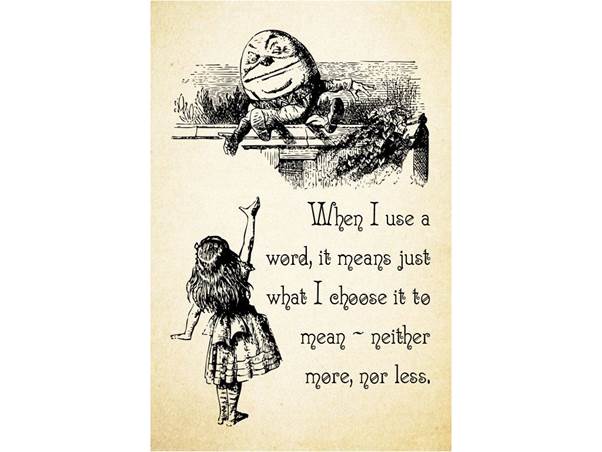
In other words, they are not, in any sense, “the principles of the Treaty”. I was not alone in being reminded of Humpty Dumpty’s words in “Alice Through the Looking Glass’:
“When I use a word, it means just what I choose it to mean – neither more nor less.”
ACT leader, David Seymour appeared on TVNZ’s Breakfast programme on July 16th, 2024. He responded to questions that pointed out his highly selective cherry-picking of words from the Treaty by saying:
“So what I’ve done is I’ve put up a set of principles that I think are useful to live by.”
In other words, ACT’s three “principles” are not intended to be “the principles of the Treaty” but rather are three ideas from ACT thinking that Mr Seymour believes should guide society. Perhaps this could charitably be characterised as what Mr Seymour wishes the Treaty had said.
The effect of this tawdry, second-rate stage magician’s trick would be to practically erase Te Tiriti/The Treaty from the law, reversing 50 years of progress towards creating the kind of society and relationships that the Crown promised in 1840.
6.0More ‘1984’ than ‘Alice Through the Looking Glass’
When people think of Orwell’s 1984, most likely the first thing they bring to mind is the role of surveillance in a totalitarian state. One of the other themes, though, is the erasure of history and control of possible futures through language:
“The Party said that Oceania had never been in alliance with Eurasia. He, Winston Smith, knew that Oceania had been in alliance with Eurasia as short a time as four years ago. But where did that knowledge exist? Only in his own consciousness, which in any case must soon be annihilated. And if all others accepted the lie which the Party imposed – if all records told the same tale – then the lie passed into history and became truth. ‘Who controls the past,’ ran the Party slogan, ‘controls the future: who controls the present controls the past.’ And yet the past, though of its nature alterable, never had been altered. Whatever was true now was true from everlasting to everlasting. It was quite simple. All that was needed was an unending series of victories over your own memory. ‘Reality control’, they called it: in Newspeak, ‘doublethink’”
Some might think the ACT Party just making up ‘neoliberal rules for living’ and pretending that they are somehow “the principles of the Treaty of Waitangi” is just weird or hubris, or some combination of the two. I see it as a much more deliberate attempt to constrain our possible futures and to return Te Tiriti to being seen as a “simple nullity”, effectively to erase it from our history. Historical amnesia plays an important part in colonisation: “if it happened in the past, it can’t be changed anyway”, “all water under the bridge”, “better to just focus on the here and now” etc. The consequence – and function – of this mindset is not having to think about the historical injustices that led to the massive inequities that characterise the here and now.
Māori have always had a different view of the past (“Ka mua, ka muri”; walking backwards into the future with eyes on the past) and through their extensive and steadfast efforts, the last ten years especially has seen a much wider acknowledgment of our past, and its inclusion finally in the school curriculum opens up the possibility of justice-informed futures. You can see how that might be a threat to those who wish instead to impose extreme neoliberal ideology
7.0 But the Bill doesn’t just leave a vacuum
The Bill doesn’t propose removal of the requirements relating to the principles of the Treaty of Waitangi from statutes. While the agenda behind the Bill is erasure of Te Tiriti from the law, that is not the entirety of the agenda. In place of the natural or legal meanings of the phrase “the principles of the Treaty of Waitangi”, it is proposed to be used as a Trojan Horse for the introduction of the ideas in Clause 6.
The proposed Principle 2 is best understood to mean:
“The Crown will not respect or protect any rights that iwi or hapū had before Te Tiriti was signed unless they have been recognised in the settlement of a historic Treaty claim prior to this Bill”.
So this proposed principle is just a further repudiation of Te Tiriti.
Principles 1 and 3 of Mr Seymour’s ‘rules to live by’ relate to matters that are already very well traversed by other law. For example, we already have the Bill of Rights Act, which sets out universal rights, and against which all new legislation must be reviewed. We already have the Human Rights Act, which brings into domestic law the rights set out through international human rights law and provides a process for enforcement. It is completely unclear how the subtly different formulations in these proposed principles would interact with these pre-existing legal requirements. It may be that as more recent legislation this Bill, if passed into law, would supersede more established law.
The proposed principles contain a series of terms:
“in the best interests of everyone”
“in accordance with the rule of law”
“a free and democratic society”
“equal before the law”
“without discrimination”
“equal protection of the law”
“equal benefit of the law”
“fundamental human rights”
Some of these have an established legal meaning; others do not. As the Bill doesn’t define these terms, it would normally be a matter for the Courts to determine their meaning. Some observers would note the irony of My Seymour attempting to justify this current Bill by saying that the Courts have had too much power in determining the meaning of the phrase “the principles of the Treaty of Waitangi” but including in the Bill multiple phrases that will require interpretation by the Courts.
Other observers, including me, have noted that concurrent with the Justice Committee’s public consultation over this Bill, the Government is also undertaking public consultation over a discussion document to fine-tune the Regulatory Standards Bill. Members of the Committee will be aware that this is an ACT Party initiative that has now been advanced and rejected several times, but passing the Bill into law is an agreement of the three parties currently forming the Government. Part of what the Bill would do is severely curtail the ability of the judiciary to perform its constitutional functions by requiring that statutes are interpreted in line with principles established through the Regulatory Standards Bill (Act to be). While the final wording is not yet set, the drafts make it clear that the “principles” will require an individualistic and libertarian interpretation of the law.
The undefined terms used in clause 6 of this current Bill will be subject to those requirements, with the likely result that they will be interpreted very differently to their current or likely legal meaning. For example, the ACT Party and its antecedents have on multiple occasions proposed “flat” taxation, and “progressive” taxation (where those who are able to pay more do so) may be seen as “discriminatory” through that libertarian lens. For another example, affirmative action to achieve equality of outcomes, is highly likely to be inconsistent with a libertarian reading of clause 6.
In other words, the cuckoo’s egg of Mr Seymour’s rules to live by is intended to plant libertarian ideas at the heart of multiple statutes.
8.0 Referendum
The Bill proposes that if it is passed by Parliament, it would take effect following a binding referendum of the public.
I have three fundamental objections to this aspect of the Bill:
By their nature, referenda are suited to simple and straightforward questions of a binary nature. While the intention of the backers of this Bill would be to present binary options (yes or no to having the Act come into force) the reality that sits behind this veneer is massive complexity, around which many people have strikingly little knowledge. It is not currently possible that a referendum could be held in which voters could cast properly informed votes.
It should never be a decision of a majority group that determines whether or not the rights of a minority group will be respected. That is a short cut to fascism.
An agreement like Te Tiriti o Waitangi creates an enduring relationship with enduring responsibilities. The Crown cannot opt out of it, and to hold a referendum on the subject is to pretend otherwise – a cynical manipulation of the public.
The proposed Treaty Principles Bill is probably the most complex and wide-ranging piece of legislation to be considered by the New Zealand Parliament, arguably ever. It is the absolute opposite of a suitable topic for a referendum.
9.0 The Bill’s stated objectives
“The overarching objective of the Bill is to define what the principles of the Treaty of Waitangi are in statute to—
create greater certainty and clarity to the meaning of the principles in legislation:
promote a national conversation about the place of the principles in our constitutional arrangements:
create a more robust and widely understood conception of New Zealand’s constitutional arrangements, and each person’s rights within them:
build consensus about the Treaty/te Tiriti and our constitutional arrangements that will promote greater legitimacy and social cohesion.”
This is all nonsense:
9.1 Certainty and Clarity
The ACT Party says that legislation that refers to “the principles of the Treaty of Waitangi” is problematic because statute doesn’t define what that phrase means, leading, presumably, to some confusion as to meaning.
In fact, while statutes usually do define some of the terms that they contain, interpretation of words, phrases and provisions is usually something that Courts do. Courts apply the language used in statutes to the real-life circumstances of the cases that are brought forward, and in this way the framework set out in a statute is given proper form. Our law is a combination of the statutes passed by Parliament, and their interpretation by the Courts to establish how the statutes should be applied to the situations that arise in the real world. Sometimes statutes are highly specific, and at other times are more general. The risk of highly specific statutes is that they don’t apply well to some real-world situations, whereas more general drafting enables the Courts to fit the law to each situation on its merits, and to enable the law to adapt to changing circumstances.
In the case of “the principles of the Treaty of Waitangi” the Courts have been interpreting the phrase in the absolutely normal way for nearly 50 years, but Government has also tasked the Waitangi Tribunal with the responsibility of interpreting this phrase. The result is that a very clear set of principles has been established, which continues to acquire more and more nuance and detail as new situations and circumstances are faced, as good law should.
The Waitangi Tribunal has made the detailed case that the current law doesn’t require “fixing”.
9.2 National conversation about the place of the Principles
Parents and teachers, especially, will be familiar with the faux-innocent look on the face of the kid who actually started the mayhem. It is easy to recognise, then, the truth behind the ACT Party’s protestation that “we think there should be a debate”.
As we’ve seen, the so-called Principles of the Treaty of Waitangi Bill has two main purposes: 1. to very largely erase Te Tiriti from the law, reversing 50 years of progress; and 2. to plant ACT’s political ideas, instead, at the heart of many statutes, very largely without scrutiny or debate. It also has another political purpose – to retain and attract racist voters to the ACT Party.
The “debate” that ACT wants is not so much a ‘dog whistle’ to racism, but more a clarion call.
I’m reminded of the stark contrast between this completely dishonest and deceptive exercise and the genuine attempt to spark a positive, constructive national conversation in 1990. As mentioned earlier, approaching the 150-year anniversary of Te Tiriti’s signing, Government funded and supported nationwide initiatives aimed at increasing Pākehā understanding of Te Tiriti and catalysing efforts to restore justice. We can’t change what happened in the past, but we can try to put right those injustices. Living honourably and ethically demands that, in fact. This was the type of conversation that started to emerge as a result of the public education programme: how to put things right?
The ACT Party says that it wants debate and a national discussion, but it simply isn’t possible for the proposed Bill to act as a vehicle for any sort of constructive discussion. What it actually wants is to reward that group of its voters who are primarily motivated by racism or, at least, a desire to return to the days when the Treaty was regarded as “a simple nullity”; to reward another group of its voters by planting ACT policy essentially into the constitutional place the Treaty holds, and to grow both groups of voters through fomenting discord.
Giving a platform to racism is thus, not a bug – it’s a feature. At the verbal level we know that racism is harmful through its impacts on identity and self-esteem, but the trashcan fire that ACT intends to ignite is unlikely to stop with words.
A lot has changed since 1990. There is more understanding of our history. There is much greater clarity that sovereignty wasn’t ceded by Māori (or otherwise fairly acquired). There are more pointers for what an honoured Tiriti might mean. How about we have THAT debate? Let’s put aside ACT’s tawdry exercise in deception and race-baiting, and instead work to resource education, discussion and honest, positive efforts to create a future that honours Te Tiriti and where we can all live good lives.
9.3 Constitutional arrangements
We don’t have a formal, written constitution but rather a set of arrangements and conventions, some inherited from England, some uniquely our own within which the law, and government, must operate.
The Courts have not (yet) ruled that Te Tiriti is part of this constitution (indeed, if it were, that could be problematic as it may suggest that it can be amended, which it cannot), but it is seen as the crucial founding document for our nation and thus part of the backdrop against which legislation must be interpreted. The many ‘Treaty clauses’ in legislation that explicitly require Government and others to act, and for law to be interpreted, in line with the treaty or its principles are very close to constitutional requirements. Substitution of ACT Party “rules for living” in place of the actual articles and principles of Te Tiriti has the dual effect of removing these Treaty-related duties and elevating a political party’s policies to quasi-constitutional status.
A second constitutional effect would occur in the relationship between Parliament and the Courts. Each institution has a constitutional role in relation to the law. Statute is written by Parliament, but interpreted by the Courts, who also are the stewards and administrators of common law. If Parliament doesn’t believe the Courts have interpreted the law in accordance with its intentions, it can change the statute, but it cannot bind the Courts to interpret the statute other than through the Courts’ own traditions and conventions of jurisprudence and statutory interpretation. Yet that is precisely what ACT’s Bill seeks to do: to set aside that careful accumulation of wisdom and, instead, to interpret the term as if it meant something that it clearly does not. It is legislative over-reach. This disruption to the relationship between Parliament and the Courts is likely to have a more general destabilising effect: if Parliament cuts across the fundamental role of the Courts (or at least proposes to do so with the Bill), might Parliament look to constrain the Courts in other ways too, say through striking down aspects of the Common Law?
A third matter with a constitutional dimension is the dishonesty at the heart of the Bill. It says it provides a codification of the Principles of the Treaty, but the ‘rules for living’ it sets out clearly are not principles of the Treaty and are not intended to be according to the Bill’s author. At the very least these breaches conventions for acceptable drafting of legislation.
Finally, the effect of the Bill would be to change more than fifty particular statutes, sometimes in highly significant ways. The amendment may well not be congruent with the purpose of that legislation (and so if proposed during the Committee stage when the Bill was considered by Parliament would have been ruled out of order) and at the very least was not part of the scrutiny of the legislation by either Parliament or the public.
Potentially the ACT Party would argue that the parliamentary and public scrutiny of this Bill itself will substitute for all the evaded scrutiny of its myriad effects through this vast range of legislation. At the heart of legal duties in respect of consultation is the standard of reasonableness. Those consulted must have reasonable information, time and opportunity to form and express their views on the topics about which they are being consulted.
The consequences to the meaning and application of multiple statutes from the Bill are such that neither the Select Committee nor Parliament itself could properly consider or debate these, and no individual or organisation outside Parliament could understand them all, consider them sufficiently to form a view and express that view. Therefore, what is proposed is wholesale change to our law without the necessary scrutiny from Parliament and the public. That is at the very least anti-democratic.
9.4 Consensus about the Treaty/Te Tiriti, and promoting greater legitimacy and cohesion
My observation is that Pākehā knowledge about Te Tiriti, the events that preceded it, and the subsequent history has very substantially declined since that highwater mark in 1990. Promoting consensus and cohesion seem very worthwhile objectives, but it strikes me that this can only occur on a foundation of shared understanding and knowledge. All the time the Pākehā population has poor knowledge of our basic history and is encouraged to think and form opinions without historical context, it seems inevitable that no consensus and cohesion are possible.
This Bill replaces the authoritative sources of meaning of the ‘Principles’ of Te Tiriti with Mr Seymour’s reckons about how we should live. That cannot possibly be a basis for building consensus and would represent a giant stride away from legitimacy. Legitimacy can only come from a clear-eyed facing up to what Te Tiriti actually means for the way we live in the modern context and taking the necessary steps to bring that about. Anything short of that can only magnify current problems, which are all the result of our current illegitimacy. We have been taking steps towards legitimacy, but what ACT proposes is to consign that progress, along with history, to the dustbin.
As for cohesion, the Committee members will be in a great position to judge the level of cohesion on these issues from the submissions received. I suspect that rather than cohesion, what you will see is a deep polarisation. While this polarisation existed before ACT’s Bill, I believe that it is unquestionably deeper as a result of it. I think that’s sad, because the more polarised an issue becomes, the harder it is to find resolution. ACT has made things worse.
When I look deeper, however, I do see something remarkable. In one of the ‘poles’ of this discussion where ACT sits alongside its friends in Hobson’s Choice (and all the other astroturfed organisations that essentially consist of the same people) I see little diversity, but a coalition of those few who stand to actually gain from libertarianism, with those clinging by their fingertips to tattered remains of empire, but most people motivated not by ethics, or evidence, or argument, but by fear of change.
At the other pole genuine cohesion and Kotahitanga are growing. The ‘coalition’ opposed to this Bill far more clearly represents the diversity of New Zealanders, not only in demographic terms but also in terms of political opinion. I have been struck by the strong opposition of important National Party figures (John Key, Jim Bolger, Jenny Shipley, Chris Finlayson for example) and conservative thinkers (such as Matthew Hooton) and organisations (businesses, churches, professional bodies) alongside Iwi, Hapū, and traditional progressives.
It seems to me that the task we should set ourselves is to reduce the fear of change and of the unknown by educating people and enabling them to see themselves in a modern society with Te Tiriti honoured.
9.5 High School Debating 101
While not part of the formal purposes of the Bill, its supporters have made several arguments repeatedly in defence of it that require brief rebuttal. Typically, these have been used in live interview situations. I have referred to basic high school debating because they are arguments typically found at that level, with a superficial credibility but unable to stand any deeper scrutiny.
“Don’t you believe in equal rights?”
Of course, ‘equal rights’ has often been a slogan used by progressives through the American civil rights movement, feminism, gay rights and other campaigns for structural change. So the challenge to belief in equal rights calls into question whether opposition to this Bill is consistent with the values of those who supported such movements.
However, what the question glides over is that there are different categories of rights, some of which are intended to be universal and some of which are contingent on circumstances. The ‘equal rights’ demands of progressive movements related to human rights or a sub-category of these, civil rights, which are intended to be universal (although civil rights might be expressed differently from country to country).
The rights of indigenous peoples are also widely recognised internationally, clearly distinguish rights that indigenous people have as distinct from non-indigenous people and are codified in the UN Declaration on the Rights of Indigenous Peoples, which New Zealand has endorsed. With or without Te Tiriti, Māori have rights as indigenous people that non-Māori New Zealanders do not have. It is clearly accepted legally and politically, both internationally and nationally that not all rights are equal.
I’m aware that some political parties still hold reservations about UNDRIP, so I will also make the point another way.: agreements and contracts between two or more parties are commonplace and, indeed, fundamental to the economy, for example. In even the most basic contract the contracting parties derive particular rights that are different from each other. That’s the point of the contract. For example, the rights of the landlord arising from a tenancy agreement are different from the rights of a tenant. A treaty, say between an indigenous people and a colonising nation, is a kind of a contract.
Actually, nobody believes in all kinds of rights being equal.
“There is no successful country in the world that allocates different rights to citizens based on their ancestry”
In fact, there are many such successful counties. The debating trick relies on the other party to the debate not being able to instantly recall such a country but assuming that the person making the claim must know it to be true.
Of course, the word “successful” does a lot of heavy lifting in the sentence – how do we decide whether a country is successful or not? Take the United States: clearly this is a country that does allocate rights differently based on ancestry. For example, many native American tribes have at least limited self-government, able to pass and enforce laws, collect taxes and so on. The country is successful, at least by some standards.
Every country with a hereditary monarchy or head of state (including the United Kingdom, for example, but Wikipedia lists 40 including others such as Spain, Netherlands and Japan, as well as another 30 or so sub-national hereditary monarchies) allocates rights differently based on ancestry. Are they all unsuccessful?
Even in the implied special case of countries that follow international law by recognising the particular rights of their indigenous populations, there are many examples. Perhaps countries such as Finland, Denmark, Sweden, Norway and Canada might suffice as examples that are unambiguously successful.
And, for all the problems that we face, most international commentators seem to regard Aotearoa New Zealand as successful. Perhaps the more interesting challenge would be to name countries that succeed despite not recognising the particular rights of their indigenous populations.


 Kiwicranks - writing by kevin Hague